Professional, Affordable & Considerate Sydney Plumbers
(02) 9072 0760
We're Open!
Professional, Affordable & Considerate Sydney Plumbers
(02) 9072 0760

Your Dux hot water system stopped working, running cold, or leaking? Before
you call a plumber, there are a handful of quick checks you can do yourself
to pinpoint the problem. This guide walks you through the most common Dux
hot water issues, what causes them, and the exact steps to troubleshoot each
one. Some fixes are DIY-friendly. Others need a licensed plumber. We'll tell
you which is which so you don't make the problem worse.
Dux is one of Australia's most recognisable hot water brands, with a
product range that covers electric storage tanks, gas storage tanks, gas
continuous flow (instantaneous) units, and heat pumps. They're a common
sight in Sydney homes, and for good reason: they're reliable, widely
supported, and built to handle Australian conditions.
That said, even the best systems run into issues over time. The average
Dux storage tank lasts 8 to 12 years. Continuous flow units can push
past 12 years with proper maintenance. When something goes wrong,
knowing what you're dealing with saves you time, money, and cold
showers.
Here's what the most common problems look like and, more importantly,
what you should do about them.
This is the most urgent issue and the one we get called about most. No
hot water is not something you want to sit on. Here's how to work
through it.
Do not attempt to repair gas components yourself.
Any work on gas hot water systems in NSW must be carried out by a
licensed gas fitter. Tampering with gas lines or components without a
licence is illegal and dangerous.
Getting warm water when you want hot? The issue is usually one of three
things: the thermostat, the tempering valve, or a failing heating
element.
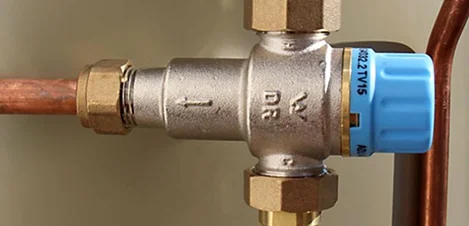
Good to know: In NSW, tempering
valves must be installed on all hot water systems. They should be
replaced every 5 years or when they start fluctuating in temperature.
If yours is older than that, it may be the culprit.
If your Dux system used to keep up with your household but has recently
started running cold mid-shower, something has changed. Here's where to
look.
A leaking Dux system needs attention fast. Where the leak is coming from
tells you a lot about how serious it is.
The Temperature and Pressure Relief (TPR) valve on the side of the tank
releases small amounts of water when pressure builds up inside. A small
drip is normal. A continuous stream is not. If water is flowing
constantly from the TPR valve, the pressure inside the tank is
dangerously high. Do not ignore this. Shut off the water supply to the
unit and call a plumber.
Water pooling around the base of your Dux storage tank almost always
means the internal lining has failed and the tank is corroding from the
inside. This is not repairable. The unit needs to be replaced, and the
sooner the better. A tank that has failed internally is a health risk.
Small leaks at pipe connections are usually a worn washer or loose
fitting. These can sometimes be repaired without replacing the whole
unit. A plumber can assess this on site.
Never ignore a leak at the base of the tank.
Rust-coloured water running from your system is a clear sign the
internal lining has failed. Showering or washing in water contaminated
with rust and corrosion is a genuine health hazard.
Discoloured water from your hot taps is one of the clearest warning
signs that your Dux tank is failing. Here's how to read what you're
seeing.
|
What You See / Smell |
Likely Cause |
Urgency |
|---|---|---|
|
Brown or rust-coloured water |
Internal tank corrosion. Sacrificial anode has failed. |
Replace ASAP
|
|
Milky or cloudy water |
Air bubbles caused by rapid heating. Usually harmless but worth
monitoring. |
Monitor
|
|
Rotten egg (sulphur) smell |
Bacteria reacting with the magnesium anode rod in the tank.
|
Service Soon
|
|
Blue or green tinge |
Copper pipe corrosion upstream of the hot water unit. |
Investigate
|
|
Metallic taste only from hot taps |
Sediment or failing anode rod inside the tank. |
Service Soon
|
The sacrificial anode rod inside your Dux tank is designed to corrode
instead of the tank lining. Once it's depleted, the tank itself starts
to rust. Dux recommends inspecting the anode rod every 5 years.
Replacing it on time can significantly extend the life of your unit.
Hot water systems aren't silent, but certain sounds are a warning.
Here's what to listen for.
Older Dux gas storage units use a standing pilot light. If it keeps
going out, here's how to approach it.
Every Dux storage tank has a Temperature and Pressure Relief (TPR)
valve. It's a critical safety device, and it should be tested every 6
months by lifting the lever briefly to ensure it's not seized. Here's
how to read what it's doing.
Maintenance tip: Test your TPR
valve every 6 months. Lift the lever for approximately 5 seconds, then
release. Water should flow freely during the test and stop completely
when released. If it continues dripping after the test, replace the
valve.
Use this as a fast diagnostic guide before calling for a service.
|
Symptom |
Likely Cause |
DIY Safe? |
Action |
|---|---|---|---|
|
No hot water (electric) |
Tripped circuit breaker, failed element or thermostat |
Check breaker only |
Reset breaker. If it trips again, call a plumber. |
|
No hot water (gas) |
Pilot out, gas supply issue, error code |
Check gas supply only |
Relight pilot. If it won't stay lit, call a licensed gas fitter.
|
|
Lukewarm water only |
Low thermostat setting, failed element, failing tempering valve
|
Check thermostat setting |
Adjust thermostat. If no improvement, call a plumber. |
|
Running out of hot water quickly |
Tank too small, sediment build-up, failed element |
No |
Call a plumber to assess tank size and condition. |
|
Leak at base of tank |
Internal tank failure |
No |
Isolate water supply. Replace unit urgently. |
|
Brown or rusty water |
Internal corrosion, failed anode rod |
No |
Stop using. Replace tank. |
|
Rotten egg smell |
Bacterial reaction with anode rod |
No |
Call a plumber to inspect and flush the tank. |
|
Rumbling or popping noises |
Sediment build-up |
No |
Flush the tank or arrange a service inspection. |
|
TPR valve continuously releasing water |
Excessive pressure or temperature, failed valve |
No |
Isolate water. Call a plumber immediately. |
|
Pilot light won't stay lit |
Failed thermocouple or low gas pressure |
Relighting only |
Relight per instructions. If it keeps going out, call a gas
fitter. |
Some hot water issues are straightforward enough to check yourself. Most
are not. In NSW, the following work must be carried out by a licensed
plumber or gas fitter, full stop:
If your Dux system is over 8 years old and showing multiple symptoms,
the honest answer is often that repair costs are approaching replacement
costs. A good plumber will give you a straight assessment, not just push
you toward the most expensive option.
At SPS Plumbers, we carry an extensive range of hot water systems in our
vehicles. Same-day replacement is available across Sydney, seven days a
week. We charge by the job, not by the hour, and we'll give you a clear
quote before we touch anything.
Call before 10:30 am and we'll guarantee same-day service across Sydney. No
hidden fees. No hourly rates. Just straight talk and quality work.
SPS Plumbers Sydney is a Multi-Award Winning Plumbing Company Delivering the Highest Standards of Service


Accredited
Professionals


Copyright 2026 | SPS Plumbers - Sydney's Plumbing Specialists | All Rights Reserved | SPS Plumbers License No. 394055C